
Best knee support guide 2026: Learn types, materials, sizing & when to use knee support for pain relief. Find the perfect knee support that actually works.
Knee pain can make even the simplest tasks feel like a monumental challenge. You could wake up feeling stiff, only to be met with shooting pains every time you try to walk around or climb a set of stairs. It is little wonder that so many people fight to find the right knee support. This guide covers everything you need to know to get started, tricking your sizing, different types, materials, and when to actually consider getting knee support. By the end, you will feel confident to pick the best option for your needs.
What Is Knee Support
Knee support is a device you wear that goes around the knee and provides added support and light compression, like a shield, to keep the joint in position while the person is moving. Good knee support will help alleviate pain and, at times, will help to reduce swelling of a joint. Good knee support will help prevent small issues from becoming large problems, and while many people refer to knee support as a knee brace, the best ones offer a fully supportive, yet totally comfortable, knee support experience.
When You Might Need Knee Support Or Knee Braces
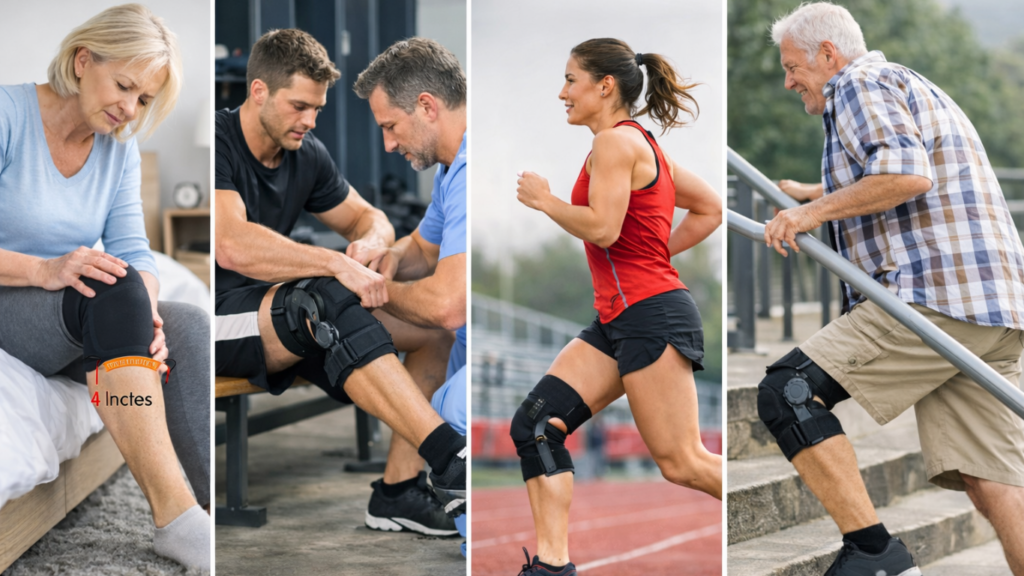
You think you might feel pain in your knee and wonder if knee support can help. This is a fairly common question, and the truth is knee support injuries. That being said, it will likely not be the answer to every knee problem. Understanding the right circumstances will ultimately save you time and money, so let me clarify.
Arthritis and Joint Wear
If you have arthritis, your knees become stiff and swollen, and pain strikes the hardest in the mornings and after long periods of sitting. This is where mild compression knee support comes in. It eases the swelling and gives you confidence to walk again. Many osteoarthritis patients feel that their quality of life improves significantly.
After Meniscus Tears or ACL Injuries
You may suddenly twist your knee while playing sports or while walking on an uneven surface. This can result in a torn meniscus or a sprained ligament. During the recovery process, your doctor may recommend a knee brace that offers support. A knee brace with a hinge can provide the side-to-side stability that you need. Without this brace, your recovery process may be extended as the injury may worsen.
Post-Surgery Recovery
Following knee surgery, your knee will need to be fully protected for the first several weeks. This is the time when a strong knee brace that keeps your knee immobilized in a straight position will be necessary so that it can heal properly. Then, your doctor will gradually change you to less supportive braces that allow for controlled movements.
Ligament Sprains and Mechanical Braces
With ligament injuries, the approach you need to take is more specialized. Your knee injuries such as an ACL, PCL, MCL, or LCL can stretch or tear while twisting. The most severe of injuries are at the top of the ladder of the treatment hierarchy.
Grade 1 sprains which are mild overstretching are treated with compression sleeves. Grade 2 tears which are partial ruptures are treated with hinged braces. Grade 3 complete ruptures are treated with surgery before bracing can even be considered. American Academy of Orthopaedic Surgeons.
For MCL sprains, a knee support with medial hinges can be used to control valgus stress. The force that causes your knee to buckle inward during a lateral hit in football or hockey. The medi physioglide hinge technology provides a protective coverage and is less cumbersome than a brace.
Sports medicine researchers have provided a warning and caution with the braces. The longer your brace, the more rapidly your quadriceps begin to atrophy. Your thigh can noticeably shrink in less than 2 weeks of bracing NCBI Muscle Atrophy Study. Braces that control motion should only be used during the high risk situations. Take them off during the non-activity to maintain muscle for your return to the sport.
Patellofemoral Pain and Targeted Straps
Ache beneath the kneecap is a common complaint among runners and cyclists. This condition is patellofemoral syndrome and is a result of poor tracking. Instead of gliding tall kneecap is grinding against the femur.
The answer is simple. Less than five dollar patellar tendon straps do a better job than bulky knee braces which can cost over fifty dollars. This strap straps directly below the knee targeting the quadriceps tendon. It alleviates pain much more than other alternatives when squatting, going down stairs, or climbing stairs . I’ve seen marathon runners use nothing but a five dollar strap.
If your knee is severely maltracking, then perhaps a knee support with a buttressing pad is a better option. These knee supports have a horse-shoe shaped cushion that sits around the knee cap. This design helps the knee remain within a certain range of movement which is critical for avoiding injury.
Osteoarthritis and Unloader Braces
The reality for arthritis patients is very convoluted. Unloader braces have the best real-world evidence, but the worst real world use. One prospective study showed that patients were being more active than the control group for the first six weeks. However, by week 24, there were no other meaningful status changes (Arthritis Care & Research 2021).
What is causing this disconnect? A 2013 survey followed arthritis patients for 1 year post unloader brace fitting. Only 25% of patients actually used the brace. Patients cited skin irritation, bulking, difficult to conceal, and damage to the brace itself as reasons for discontinuing the use of the brace.
Dr. Jeffrey Peng recommends neoprene sleeves for most arthritis patients, which is supported by a study from 2011. The study published in the US Library of Medicine determined that elastic knee sleeves improved functional ability and decreased pain when performing daily activities . There is also an improvement in both static and dynamic balance. For older adults, this fall prevention effect is highly beneficial for those who want to maintain an active lifestyle.
Summary
You have also learned the four major injury categories. For meniscus tears, what works best is the use of padded sleeves. Whereas, for ligament sprains, hinged braces that prevent sideways collapse are a necessity. Below the kneecap and with a simple strap is all that is needed to resolve patellofemoral pain. Before an osteoarthritis patient goes for a heavy unloader brace, a neoprene sleeve is worth a shot. The injury dictates the brace’s complexity; a minor injury would not require a large brace. For further reading, refer to the AAOS Complete Guide to Knee Braces. Now, you can use what you’ve learned in your sport.
For Runners and Active Athletes
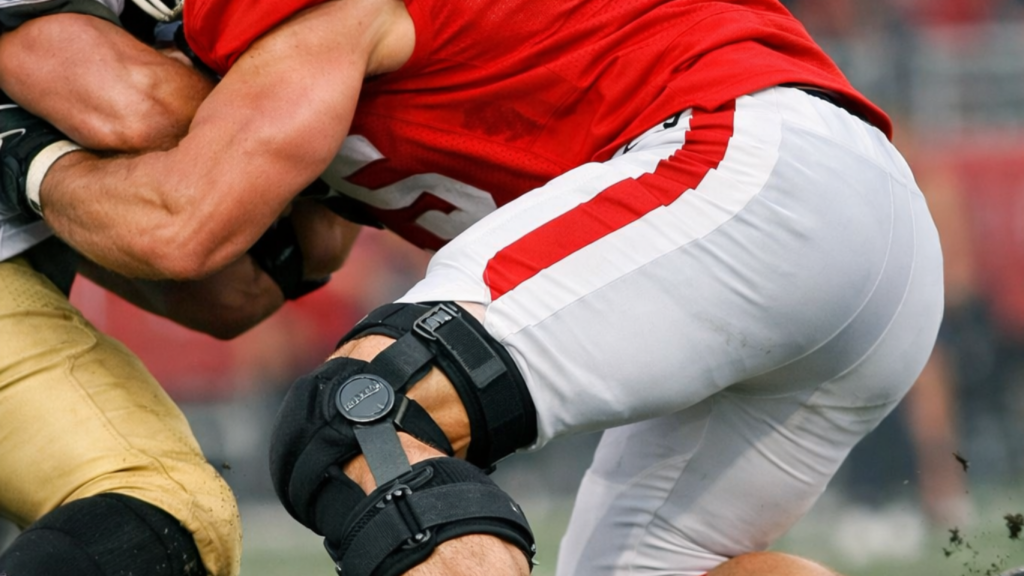
Different sports require different types of knee braces. A volleyball player needs a brace that allows for jumping, while a football lineman needs something that can take a hit. A runner usually just needs something that is lightweight with some form of compression.
Athletes and runners will know that after heavy exercise, knee pain is very common. For this reason, knee support is recommended as it acts to minimize direct contact with the knee. This will prevent small injuries from developing into larger, more serious injuries. Many athletes train in lightweight sleeve knee supports and use hinged knee supports during more serious competitive sports.
Below is a breakdown of what works best for each sport based on research and feedback from athletes.
Brace for Basketball and Volleyball
A ligament can tear in an instant in both sports. You jump. You land. You cut. You can land awkwardly on an opponent’s foot.
A knee brace with hinges is a good investment for these sports. Basketball players often buy from the DonJoy Armor series. These have hinges on both sides to control hyperextension and reverse a situation.
Brace for Tennis and Pickleball
In both sports, you will need to those who are doing a lot of skill actions need to do a lot of quick lateral movements.
Where the simple patellar strap really excels, however, is that it exerts localized pressure on the patellar tendon just beneath the kneecap, modulating the tendon’s vibration frequency and reducing the pain-causing oscillations, allowing you to play through discomfort without further exacerbating the injury.
Knee Pads for Wrestling and Jiu-Jitsu
Sharply contrasting the above sports, where grappling is concerned, you can expect to spend hours on your knees, which makes the mat burns bad enough without the added annoyance of a ligament injury.
Wrestlers require padded knee support that is durable enough to withstand scrambles. The Asics Super Sleeve is well known in the community. It has a thicker foam padding over the kneecap. The fabric of the sleeve is a nylon that is very resistant to mat pilling.
Here’s the tip most wrestlers understand: make a small cut on the backside of the knee. The popliteal area needs a way for ventilation to prevent overheating. Without it you will find yourself in an oven in the practice of just a single session. This takes a pair of scissors and less than five seconds to make a good sleeve great.
The most recommended knee pads among jiu jitsu practitioners is the McDavid Hex knee pad. What sets this pad apart is the use of hexagonal foam. The hexagons can shift their position with the knee movement. This flexibility means you get protection without the kcalx restriction of knee movement. Jiu jitsu players need full knee flexion to execute the rubber guard and for tight passing. Bulky pads will prevent them from using those techniques.
Braces for Football and Hockey.
Football and hockey aren’t just about movement. They are contact sports in which players get hit from the sides, rolled on top of, and are required to fall on either ice or turf.
All of these activities mean you are required to be in a high impact environment. Specifically, you need knee braces with hard plastic shells and the Shock Doctor is a popular football lineman choice. This knee brace has a rigid frame that is covered with energy absorbing foam. If you’re the kind of player that takes the brunt of direct impact of over 200 pounds then this brace is for you.
Hockey players are a bit different. They already have most of their knees covered with pads. This means you have to be mindful not to add another brace that will be bulky. The best option becomes having integrated knee support that is built right into their hockey girdle. This is the case with Bauer who have girdles that come with removable knee inserts. These inserts come with either a soft sleeve that is most suitable for goalies or a hinged brace that works best for forwards.
The Playmaker II Knee Brace is a great option for football players. The Playmaker II has a 4-point hinge system rather than a typical 2-hinge system. 4-point hinges spread force through a larger area, meaning you can avoid a lot of pain from lateral knee impacts.
Summary
This summary is essentially a guide dividing knee injuries by sport. Runners will want a thinner sleeve to minimize restriction to their knee. The same goes for weight lifters, but they will want a thicker sleeve. Ball sports like basketball, volleyball, and football will want hinge style braces to avoid ACL tears. Tennis is a little different since the sport is less physically demanding on the knees, so a simple patellar strap is all you need.
Wrestling and BJJ require padded braces to protect against impacts. Football and hockey are the same and need hard-shell impact braces. Never use a running sleeve for football and never use a hinged brace for weightlifting. Every sport has it’s unique patterns and so does a knee brace. If you want sport specific advice, you can use the Sports Medicine Knee Brace Database.
For Older Adults and Daily Activities
As a result of the natural aging process, individuals will also notice a natural decline in the strength of their knee joints. This will make previously simple tasks such as climbing stairs very painful. By providing an extra level of support to the knees, the knee support will also help to reduce the fear of falling. Many seniors have been able to maintain their normal routine once they have been fitted with a quality knee support.
When You Stand or Walk for Long Hours
If your job requires standing for long periods of time, compression supports will come in highly recommended. They will also reduce the level of swelling and fatigue you feel in your knees at the end of a long day at work. A knee support that offers compression will also aid in more blood being delivered to the knee joint which in turn helps with blood circulation. Shopkeepers, factory workers and teachers often use compression knee support to finish a long day with less pain.
Different Kinds of Knee Supports
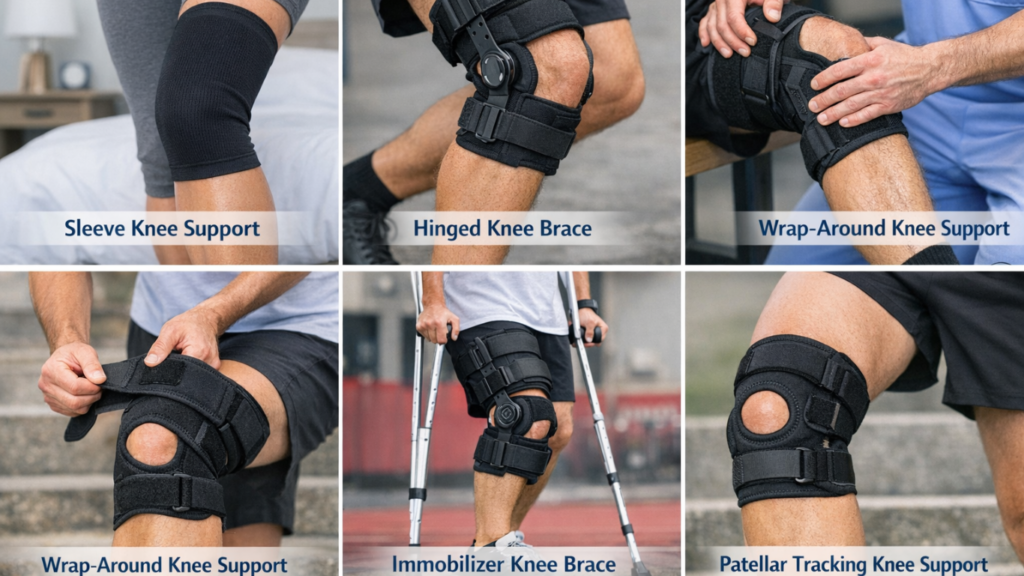
You’re ready to buy knee support, but there are so many to choose from. They all look different and say they do different things, and it becomes confusing. I can help sort these out.
Sleeve Knee Support
The knee support that is a sleeve is the most common one. Also, the most basic one. It just slides on like a tube and it provides compression. It is best to be worn during day-to-day activities, or by people with a smaller case of arthritis. This is good for someone with a hurt knee that is not too serious.
Hinged Knee Brace
The hinged knee brace is much more intense. They are built with a hinge on each side. This is the best one side-to-side stability brace, and is best recommended for someone with ACL or MCL injuries. It protects against sudden twists of the knee. This is a favorite among athletes as it provides good stability while still allowing good flex.
Wrap-Around Knee Support
Wrap around should be the best one to buy if you plan on having to adjust it, as it can be tightened or loosened easily. You can do this as the day goes on while you still have the issue of swelling. People with arthritis love this as they are able to control the looseness.
Immobilizer Knee Brace
The most serious option is the immobilizer knee brace. This is super serious and is for people with extreme injuries, or people that just had a knee or surgery. There are a lot of strong straps and a bar that just makes your knee stay straight. If this is on, you can’t do a normal walk like you used to be able to do. You do this for a short time until you can buy a new one that allows you to walk normally.
Patellar Tracking Knee Support
Patellar tracking knee support is designed specifically for knee caps. It features a unique hole or strap that holds the knee cap in the correct position. This is typically selected by runners who have patellar tracking problems or runner’s knee. It alleviates pain associated with stairs and squatting. This knee support is lightweight and quite comfortable for frequent use.
Types of Knee Support Materials
The material used for the product determines how comfortable and effective the knee support is. Some materials perform well in the short term then cause problems down the line. Others remain supportive for the long term. Understanding the material will help avoid future disappointments.
Neoprene is a heat retentive material that provides good support and a high level of compression and warmth. Unfortunately, neoprene is not breathable and can cause discomfort due to heat and sweat build up. Because they are lightweight, blends of mesh and nylon are more comfortable to wear. Because of the high level of airflow mesh offers, your skin will remain dry and cool, even on the busiest of days.
Because of its natural anti microbial properties, and odor resistance, bamboo is a common choice for people who have skin sensitivities. The use of bamboo for knee support is common due to its anti odor quality, which is superior to synthetics. Excellent cushioning is offered by memory foam and gel inserts. These materials are effective in alleviating pressure points due to prolonged walking or standing.
Sizing Guide of Knee Support
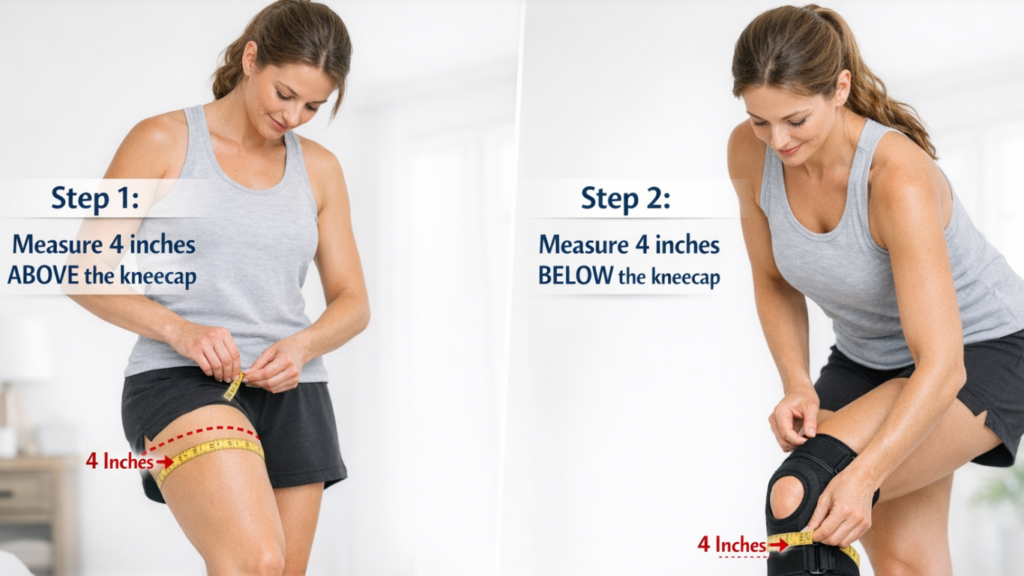
Getting the right size is crucial. Many people skip this part and later realize their mistake. This is especially disappointing when the knee support is expensive. Here is a measurement guide that is easy to use.
Why getting the right size matters
If it’s too big, the knee support will slide down while walking so you won’t gain any support. If it’s too small, it will restrict blood flow and can cause swelling or numbness. When you get the right size, knee support will feel good, and it will provide the support you need.
How do you take your own measurements so that you can order the right size?
Take a flexible tape measure and measure 4 inches above the center of your knee, and then measure 4 inches below your knee. Make sure you record both measurements. Always take a measurement for both legs. Some people’s legs can be different sizes. To get the most accurate measurement, stand still when you’re measuring.
How do you know what size to order?
Most companies have size charts right next to the knee support. Some charts use Small, Medium, and Large. Some charts use numbers or centimeters. If your measurements show that you could fit into two sizes, you should choose the larger size. A loose fit is better than a tight fit.
What mistakes do people make when picking a size?
The biggest mistake you can make is guessing what size you are. It’s incorrect to assume that your size is the same as your pants size. Some people do not take into account that legs swell. This is the most accurate measurement. Always measure when swelling is at its peak.
The Smartest Choice When Selecting Knee Support That Lasts
Wise knee support selection will save you money and aggravation. Pay less attention to price and aesthetics and more to quality and how it integrates into your lifestyle. Known value seekers ask purchaser specific questions before hitting the buy button.
How to get the best fit for your knee support. The knee support should definitely feel snug but not tight. It is a literal regulation that you should be able to fit two fingers comfortably under the edge. If it leaves red marks on you, it is too tight. Good knee support will feel tight but it should never be too tight to the point where it is restricting your blood flow.
Making a Long Lasting Purchase on Knee Support
Savvy shopping for knee support means less money, time, and energy wasted. Avoid being concerned with just the price, or the look, of the knee support. Rather, look towards its quality, and if it fits with how you live your life, or if it meets your needs. Wise buyers know how to ask the right questions before making the purchase.
What to Know About your Knee Before Buying a Brace
Before we get into the support brace you want to get, consider your knee a bit more like a mini suspension bridge than a more simplistic door hinge. Why is this important? Bridges need a plethora of different components to survive a storm. Just like them, your knee needs the same.
Your knee is a joint of 3 bones; the femur, the tibia, and the patella. The femur is the uppermost bone, which rests above the tibia. The patella then sits in front and helps shield all the components. Strong surrounding muscles, called the Quadriceps and Hamstrings, stabilize the joint. Your quad flexes to straighten the leg while your hamstring pulls it back. In dynamic stabilization, muscles keep the joint tracking accurately. Johns Hopkins Anatomy Guide
When all of these structures work as intended, your joint will be healthy, but when they don’t there will be problems. This is where the ligaments come in. Like many of us, your knee relies on these four primary ligaments. The ACL and PCL sit criss-crossed inside the joint and help stabilize the knee. The MCL and LCL sit on the inner and outer side of the knee to help stabilize side to side movement.
Shock absorbers called menisci are located between your bones. They evenly distribute weight every time you move. A 2025 biomechanical study shows that a **knee support** reduces frontal plane knee acceleration Biomechanics Journal 2025 They reduces the
Things to Consider Before Purchasing Knee braces
- Make sure that you take measurements of your legs, and do this if you haven’t done it already, just above and just below the knee. This is to help you to purchase the right size.
- After this, ask yourself how you spend your day? Do any of the activities in your daily life involve standing for long periods of time, or involve sports? When buying a support, consider these for your daily life.
- Need to know that company has a policy on returns. This is true for big and small companies.
- Read the reviews. Pay special attention to knee problems that are similar to your own.
When Knee Support is NOT Helping, and Might be Making it Worse
The right knee support is supposed to relieve, and solve the problems that you have with your knee.
- Knee support that is too tight or of poor quality may cause you to have future problems making you have to deal with pain in other parts of your body.
- Problems with your hip or your ankle may arise from a lack of support in other areas.
- If you start using knee support and you notice more swelling, or less feeling in the area, or you have pain in the area, or you have any kind of irritation of the skin (this is really just a fancy way of saying you have a rash), then you should stop using that support immediately. The wrong knee support can make healing more difficult.
What Buyers Often Overlook
While most buyers focus on price and appearance, they miss out on the most important factor – breathability. If the material is not breathable, you will feel hot and sweaty in no time. Sweat is a skin irritant and can cause a lot of discomfort. However, good, breathable knee support will enable you to stay cool and comfortable for hours on end. Always check the material description before purchasing.
Wash and Wear Schedule
What is the time limit for knee supports? It depends on your activity level. For acute injuries, wear the supports for all activities that involve bearing weight. You should remove the brace for sleeping unless your surgeon says otherwise.
Worn rigid braces during sleep cause two problems. First, the body changes position naturally every twenty to thirty minutes. A brace that is locked in will fight these micro-movements. It is likely that you will awake sore from movement of the brace. Second, the skin is damaged from the longest brace in place, creating a sore from pressure. After eight hours, the skin breakdown is likely to occur Mayo Clinic Pressure Sore Prevention.
Washing the brace is very important. Neoprene collects sweat and the bacteria will grow and thrive and then smell very badly. You should wash the brace every week, and never place it in the dryer. The heat will damage the elastic fibers. Air drying is recommended and will maintain the compression gradient for future use. A reader claimed that the brace lasted for seven years because it was well maintained. The same brace from a different friend, who used it in the dryer, failed in six months.
Summary
You have learned to fit, clean, and wear your brace in a safe way. Measure your knee at 30 degrees of bend. With any straps, you should be able to slide 2 fingers under the clasp. Rigid braces should be removed when you sleep. Hand wash neoprene sleeves weekly and air dry them. Most of the time, the brace can be comfortable against bare skin, but it is better to have a thin pair of leggings under it for walking than over a thick pair of leggings for sports. Numbness, pain, or changes in the color of the skin should cause you to stop using the brace.
A brace that is well-adjusted may aid your movement. One that is poorly adjusted may slowly worsen your condition. For an adjustable fit chart, please refer to the AAOS Knee Brace Fitting Guide.
Medical Disclaimer
This material is for educational purposes only. For any new treatment methods, seek professional advice. Everyone’s anatomy and injury patterns are different. Your physician can give you tailored advice based on imaging and the physical exam. This piece is for reference and links to manufacturers and medical institutions.
Questions People Ask Most
Do knee supports actually work?
Yes, the knee supports work. But most of the time, people need to rest and do the right exercises in order to achieve that. It is common to feel real relief a few days after starting to use knee support.
What is the best support for knee pain?
That depends on the specific situation. Compression sleeves are good for mild arthritis. If you have a ligament injury, hinged knee braces are a better option because they provide better stability. Make sure to get knee support that is the right size and allows you to do your most common activities.
How to cover knee pain?
Combination of appropriate knee support, rest and ice usually works for knee pain. Gentle stretching and strengthening exercises are helpful as well. Make sure to also avoid any high-impact activities until the pain subsides. Appropriate knee support along with the right activities often provides quick relief.
Can I wear knee support everyday?
Of course, you can wear knee support every day, except I would recommend not using knee support if it is uncomfortable. Many people find it easy and comfortable to wear knee support for long hours. Just don’t wear very tight supports all day. Sometimes, take your knee support off and let your muscles breathe and take a break.
What is the fastest way to relieve knee pain?
Usually the best and fastest way to relieve knee pain is to apply ice to the knee for 15 minutes and use the best support for that knee. Keep your leg in a position of elevation to better assist it in resting. If you don’t then the swelling may take more time to go down. Many hours may be wasted before you notice the benefits of this process. Gentle compression certainly helps.
What are signs I need knee support?
If you start to notice pain when walking, using the knee support is a good idea. If there is pain that lasts a week and interrupts your sleep, consider the use of knee supports. If your knee gives way, if you experience swelling, or its instability, be warned.
How to reduce knee pain without surgery?
Possessing good knee support, performing some light exercise, and keeping a good body weight can help to reduce without the need for surgery. High-impact activities should be avoided, elbows should rest, and ice to the knee should be applied. Many people are able to keep their knee pain down for a long time using this system without the need for surgery.